The core difference is straightforward: a standard walker stays put when you lean on it; a rollator rolls. That distinction drives almost every other difference between them - when each is safe, when each is useful, and what happens when you pick the wrong one.
Who should use a standard walker
A standard walker - or a front-wheeled walker, its close relative - provides resistance. When you push down on the handles to steady yourself, the device does not move. That resistance is exactly what someone with significant balance impairment needs.
If you are recovering from hip or knee replacement surgery, you will almost certainly be prescribed a standard walker for the early recovery phase. The reason is the same: when you are learning to bear weight on a repaired joint again, you need a device that holds still when you put weight on it.
Parkinson’s disease is another situation where walkers often outperform rollators in safety, particularly when freezing of gait is present. A front-wheeled walker’s slight rolling resistance can actually help initiate steps, while the non-rolling rear legs provide a backstop if momentum is lost.
The cases where a standard walker is appropriate:
- Significant balance impairment where you need to bear weight on the device
- Post-surgical recovery (hip, knee, lower limb)
- Situations where a rollator rolling unexpectedly would be a fall risk
- Users with unpredictable gait who cannot reliably control brakes
Who should use a rollator
A rollator works well when endurance or pain - not balance - is the primary limitation. The user whose problem is “I can walk fine for a few minutes but then I need to sit down” is a good rollator candidate. So is the user who walks steadily but carries things awkwardly, or who needs to cover longer distances at a reasonable pace without stopping to lift a walker every step.
The distinguishing feature of a rollator is its seat. For users who need to rest periodically while walking - someone with heart failure, COPD, or arthritic hips - the ability to stop, set the brakes, and sit down anywhere is genuinely useful. A walker does not offer this.
Rollators also handle outdoor use better. Larger wheels, a rolling frame, and the ability to manage uneven ground make a rollator far more practical on paths, in parks, or at outdoor events than a standard walker.
The cases where a rollator is appropriate:
- Endurance is the main limitation, balance is reasonably intact
- Regular outdoor use on paths or uneven ground
- Frequent need to sit and rest while out
- Carrying items while walking (the built-in basket)
- Long-distance indoor use where lifting a walker is tiring
The posture problem
Standard walkers create a tendency to hunch forward. The user leans slightly over the frame to reach the handles, and this posture becomes habitual. Over time, it can worsen back and neck strain.
A well-fitted walker - with handle height at the wrist crease when arms hang relaxed - minimizes this, but the posture problem is real and worth monitoring. Occupational therapists who prescribe walkers will often address this in fitting and training.
Rollators encourage a more upright posture because the frame rolls alongside the user rather than in front of them. The natural walking rhythm is better preserved. This is one of the practical reasons rollators are preferred for longer-distance or outdoor use when balance allows.
Rollator brakes: the part that matters most
A rollator is only as safe as its brakes, and the brakes only help if the user can operate them reliably.
Loop brakes (squeeze to slow, fully squeeze to lock) work like bicycle brakes. They require meaningful grip strength. Users with significant arthritis, limited hand strength, or neurological conditions affecting hand function may struggle to apply them quickly enough when needed.
Push-down brakes lock when the user presses down on the handles - the handles descend slightly. These require less grip strength and can be easier for users with hand weakness. The trade-off is that the mechanism is less intuitive for some users, and accidental braking can interrupt gait rhythm.
Before choosing a rollator, the user should physically test whether they can operate the brake system reliably. A rollator whose brakes cannot be engaged quickly and consistently is more dangerous than a standard walker.
Weight and foldability
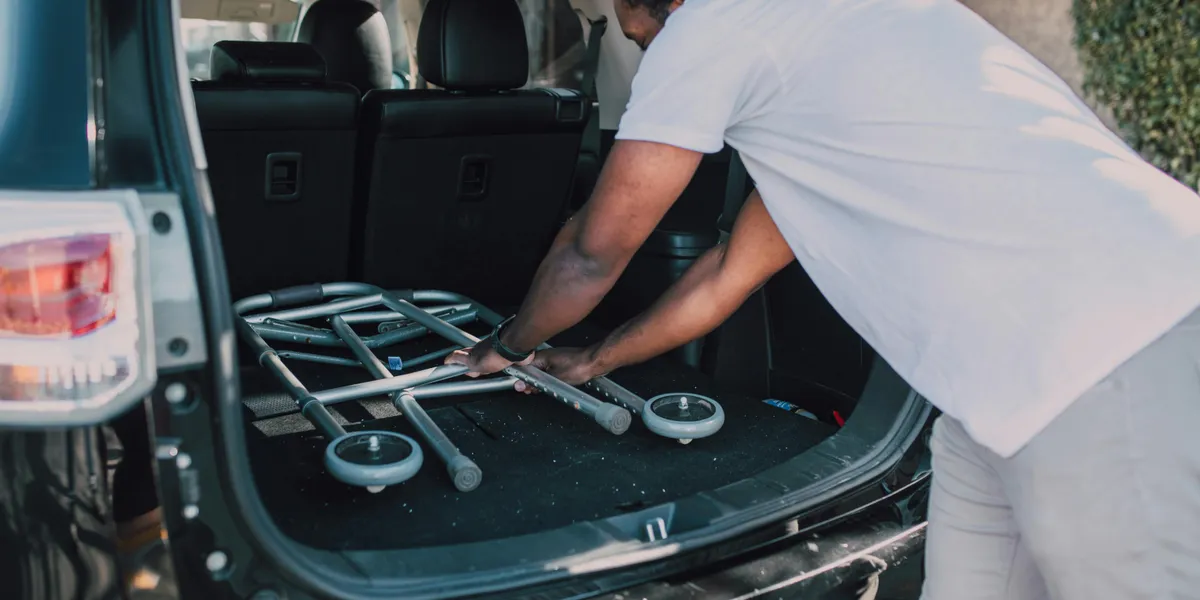
Both types fold flat for transport, though the mechanisms differ.
Standard walkers fold by squeezing the sides together and collapsing the frame. Most weigh 6-8 lbs, making them easy to manage alone.
Rollators are heavier - typically 12-18 lbs for standard models, up to 25 lbs for heavy-duty versions. They fold similarly but require lifting into a car boot. The weight is something to check against what the user (or their caregiver) can realistically manage.
If the device needs to be loaded into a car frequently, weight matters. A rollator in the 12-14 lb range is manageable for most adults. At 20 lbs or above, plan to do it with help.
Side-by-side summary
| Standard Walker | Front-Wheeled Walker | Rollator | |
|---|---|---|---|
| Wheels | None | 2 (front only) | 4 |
| Stability when leaned on | Maximum | High | Lower - rolls unless braked |
| Gait pattern | Lift-step | Push-step | Natural rolling |
| Outdoor use | Limited | Limited | Good with large wheels |
| Seating | None | None | Built-in seat on most |
| Brake required | No | No | Yes |
| Best for | Post-surgery, significant balance issues | Moderate balance issues, Parkinson’s | Endurance limitation, outdoor use |
When neither is the right answer
Both walkers and rollators require the user to stand and walk. When that is no longer safely possible - when standing balance has deteriorated to the point where any walking is a fall risk, or when fatigue prevents any meaningful walking distance - a wheelchair is a more appropriate solution than a better walker.
The transition is not always obvious. A person who is falling with a rollator but has been told to “keep trying” may simply be in the wrong device category. An occupational therapist or physiotherapist can evaluate whether a walker is still appropriate or whether a seated mobility aid is safer.
For more on the seated mobility options that come next, how to choose a wheelchair and the power wheelchair vs mobility scooter comparison cover the adjacent decisions.
Frequently Asked Questions
- What is the main difference between a walker and a rollator?
- A standard walker stays put when you lean on it; a rollator rolls. That difference determines when each is safe. Someone who needs to bear weight on the device to catch themselves needs a walker. Someone whose main limitation is endurance, not balance, is a better rollator candidate.
- Can you use a rollator outdoors?
- Yes. Rollators handle outdoor use better than standard walkers, particularly models with larger wheels (8 inches or more). These can manage gravel paths, mild slopes, and uneven pavement. Standard walkers are primarily indoor devices - outdoor use on anything other than flat pavement is awkward and tiring.
- How heavy is a rollator compared to a standard walker?
- Standard walkers weigh 6-8 lbs. Rollators are heavier - typically 12-18 lbs for standard models, up to 25 lbs for heavy-duty versions. If the device needs to be loaded into a car regularly, that weight difference matters and is worth checking against what the user or caregiver can manage.
- Which type of rollator brakes should I choose?
- Loop brakes (squeeze to lock) are more intuitive but require meaningful grip strength. Push-down brakes require less grip and suit users with arthritis or hand weakness, but can feel less natural. Before buying any rollator, test whether the user can operate the brakes quickly and consistently.